
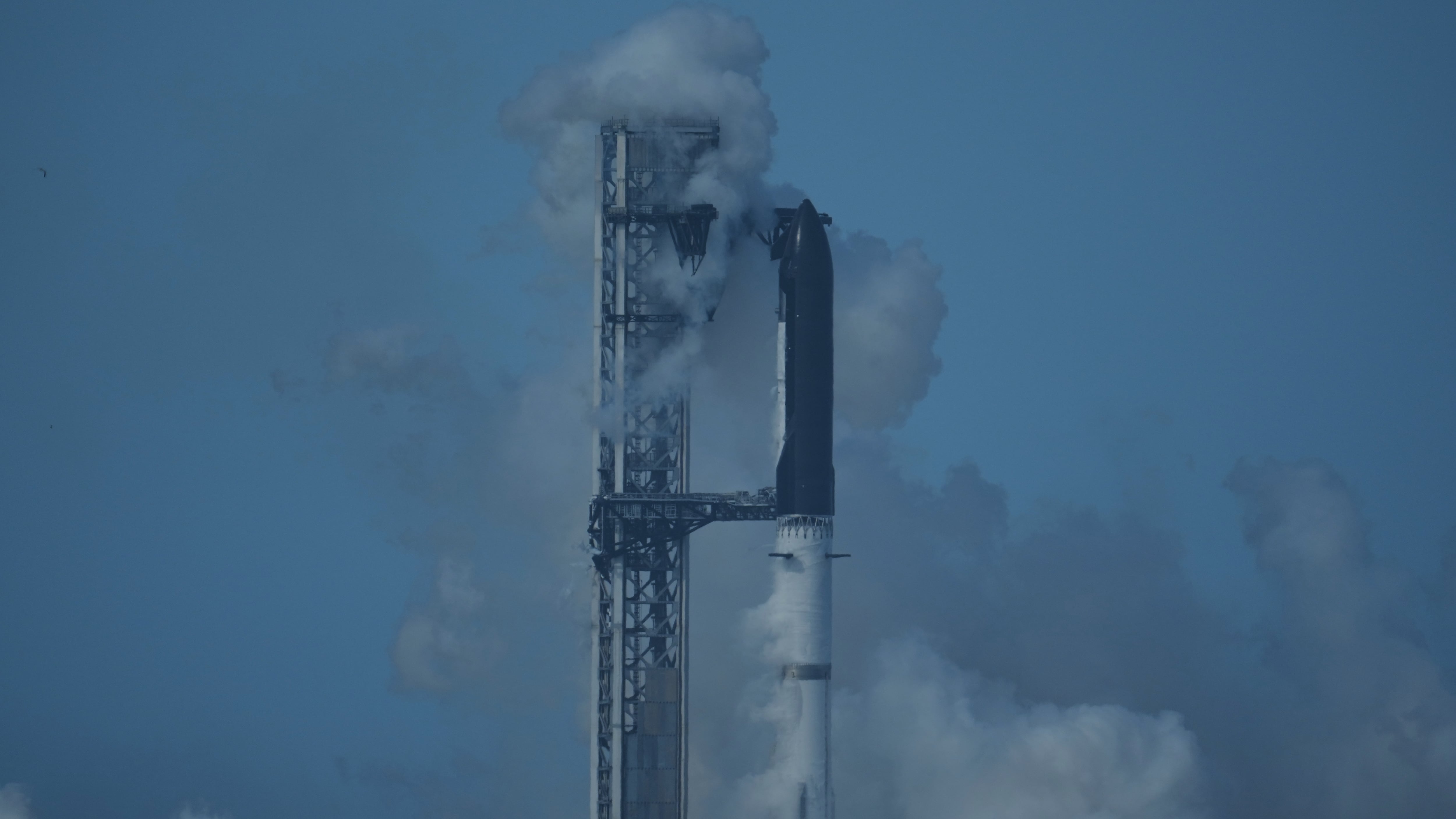
SpaceX’s mega Starship rocket came within a second or so from blasting off on a test flight Thursday but some of the engines failed to start, triggering a launch abort.
Elon Musk's company said it will have to figure out what went wrong before making another attempt to send Starship on a space-skimming flight halfway around the world. It was supposed to be the 13th flight for Starship, which at 407 feet (124 meters) tall with 33 main engines is the world’s biggest and most powerful rocket.
SpaceX's launch webcast showed the start of engine ignition three seconds before the planned liftoff, viewed from a drone high above the pad. Whichever engines fired abruptly shut down, with the rocket remaining anchored to the pad. The launch team immediately began draining the fuel from the rocket.
“Next launch attempt hopefully in a few days,” Musk announced via X.
Everything had been going SpaceX's way, including the weather, until the partial engine ignition.
Twenty of SpaceX's newest and most advanced Starlinks were on board Starship for release during the planned hourlong flight. The internet satellites were going to try communicating with Starlinks already in orbit while taking photos of Starship's heat shield. Neither the first-stage booster nor spacecraft were meant to be recovered, with both ending up in the sea.
NASA is counting on Starship to land its astronauts on the moon in the next few years. The space agency has hired SpaceX and Jeff Bezos' Blue Origin to build and fly the lunar landers that will return humanity to the surface of the moon after an absence of more than half a century.
Both companies need to have their landers — Starship and Blue Moon — ready to fly by next year so that the newly named Artemis III crew can practice docking their capsule with them in orbit around Earth. The mission after that — Artemis IV planned for no earlier than 2028 — would use one of those landers to take two astronauts to the moon's south polar region.
___
The Associated Press Health and Science Department receives support from the Howard Hughes Medical Institute’s Department of Science Education and the Robert Wood Johnson Foundation. The AP is solely responsible for all content.
Copyright 2026 The Associated Press. All rights reserved. This material may not be published, broadcast, rewritten or redistributed without permission.