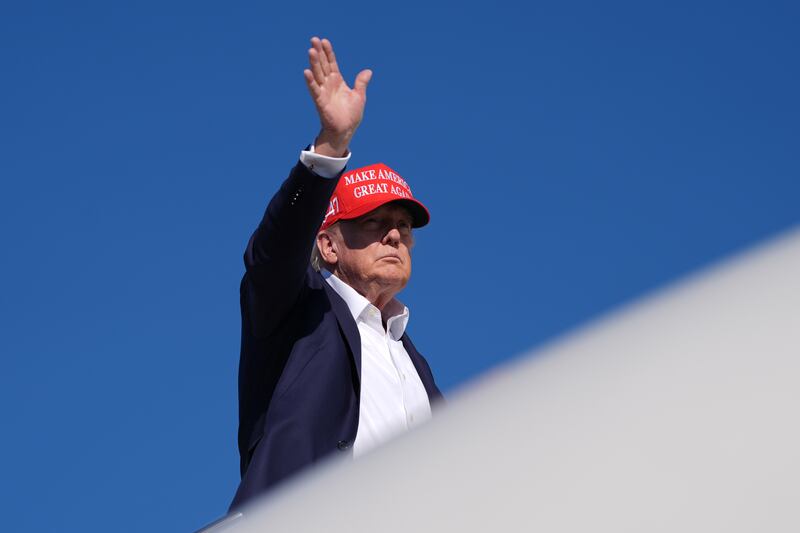

President Donald Trump gave sizable holiday gifts to four White House aides, according to new financial disclosures released by the administration. A White House official, who was not authorized to comment publicly and spoke on the condition of anonymity, said Trump “has a longstanding practice of giving Christmas gifts to people in his orbit, including at times employees and aides, both in government and in his time in the private sector.”
The Justice Department is demanding testimony before a Florida grand jury in an investigation aiming to establish an intelligence community conspiracy against Trump, according to multiple people familiar with the matter. The new subpoenas represent an escalation in the year-long investigation.
Americans are more skeptical of government information than they were a few years ago, with majorities now saying they have little or no trust in federal governmen tinformation about elections and politics, foreign affairs or the environment, a new poll finds.
Here’s the Latest
Trump’s map-making on social media stirs controversy in North Atlantic
During a flurry of social media posts over the long holiday weekend, Trump posted a map showing the U.S. sprawling across all of North America and extending to Greenland and Iceland. The map was colored in the red, white and blue stars and stripes of the U.S. flag.
The Truth Social post offered no explanation but recalled Trump’s earlier talk of making Canada the 51st state and his repeated musings about taking over Greenland, Denmark’s self-governing territory.
“It’s disturbing and, in many ways, completely inappropriate,” Danish Foreign Minister Lars Løkke Rasmussen told the national broadcaster DR on Tuesday. “It’s obviously a sign that the U.S. president still harbors some kind of maximalist vision in his own mind. We need to rein that in.”
Iceland’s Foreign Secretary Thorgerdur Katrín Gunnarsdóttir summoned U.S. Ambassador Billy Long to a meeting and said she made it clear that the post was unacceptable, national broadcaster RÚV said.
US banning dairy products, most alcohol and motorcycles from Canada in growing trade war
The United States is banning the import of some dairy products and motorcycles from Canada, along with most alcoholic beverages, the White House said Tuesday, as part of a trade war that shows little sign of cooling off.
The ban will take effect Sept. 29 and comes after retaliatory tariffs promised by Canada kicked in earlier Tuesday on $20 billion in U.S. imports. Canada had responded to tariff moves by Trump after trade talks between the countries broke down last month.
Trump also moved to shut Canadian products out of large, long-term U.S. government contracts and directed the U.S. General Services Administration to declare Canadian products ineligible for those contracts until Canada allows “full and fair reciprocity″ for American products.
Canadian Prime Minister Mark Carney said Canada’s strategy was about becoming more independent and vowed to speed those efforts. “It’s about ensuring that no country can hold us hostage. And that we can live how we want to live,” he said.
Poll: Fewer have a high level of trust in government certifications of election results
As the 2026 midterms approach, public concern about the accuracy of the election results is widespread, the AP-NORC / USA Facts survey finds.
Only 34% of U.S. adults say they trust the government certifications of election results — the last step in a bureaucratic process where state and local officials confirm the vote count — “a great deal” or “quite a bit,” which is down slightly from 40% in 2024.
Just under half of U.S. adults are “extremely” or “very” concerned the federal government will publicly discredit or question election results, tamper with election results, or pressure state election officials to change how they certify or report results.
Over the past few months, Trump has repeated long-debunked allegations of mass voter fraud in the 2020 election and attempted to place new restrictions on mail ballots in time for the midterms.
Trump cheers anti-immigration German party’s strong showing in regional elections
Trump said the Alternative for Germany, or AfD, performed strongly in Sunday’s vote in Saxony-Anhalt, because the region’s voters “got tired of the absolutely horrible Immigration rules and regulations which have hurt Germany so badly.”
“THEY ARE ON THE RISE, and not going to take it anymore!” Trump said in a social media post, offering a somewhat belated reaction to the far-right party’s surge to a landslide victory in a regional election.
AfD fell just short of a majority, but is in a strong position to form the first far-right state government since the Nazi era.
The victory for AfD, which also has a pro-Russia tilt, is a major distraction for Germany and center-right leader Chancellor Friedrich Merz at a time when Europe faces several challenges, including Russia’s continued aggression against Ukraine, a suspected sabotage campaign targeting NATO countries, and difficult dealings with Trump.
Poll: Belief in government information has become more partisan
Trust in government information has become more partisan since Trump’s first term, the AP-NORC / USA Facts survey finds.
Democrats were generally less likely to trust government information in Trump’s first term, but not dramatically more than Republicans. That shifted when control of the White House changed hands.
Republicans’ mistrust in government information rose while Biden was president and fell after Trump took office. Meanwhile, Democrats’ doubts declined under Biden but spiked when Trump regained power.
For example, 61% of Democrats now have low trust in information about the federal budget, compared to 42% of Republicans, while 60% of Democrats have low trust in information about crime, compared to only 32% of Republicans.
The only issue without a substantial partisan divide is vaccination recommendations and safety: about 6 in 10 Democrats, Republicans and independents have low trust in government information on vaccination recommendations.
Mistrust of federal government information is rising, a new poll shows
Americans are more skeptical of government information than they were a few years ago, with majorities now saying they trust information from the federal government “only a little” or “not at all” when it comes to education, the environment, foreign affairs or elections and politics, among other issues.
Mistrust in what the federal government says has risen at least slightly on nearly every topic that was asked about in an AP-NORC / USA Facts survey from 2019. That includes education — which has risen from 37% in 2019 to 53% now — with a 9-percentage-point spike in the last year.
The findings come after a year and a half of upheaval in the executive branch. Trump began to dismantle key parts of the federal bureaucracy soon after entering the White House for the second time, moving to end longstanding programs and shutter entire agencies.
Exclusive: New grand jury subpoenas in investigation of Trump-Russia probe, AP sources say
The Justice Department is demanding testimony before a Florida grand jury in an investigation aiming to establish an intelligence community conspiracy against Trump, according to multiple people familiar with the matter.
New subpoenas being issued to former government officials represent an escalation in the year-long investigation as the Justice Department pursues a loosely defined theory that members of the intelligence community who scrutinized Trump over the last decade, including over Russian interference in the 2016 election, conspired against him and violated his rights.
Investigators in recent days contacted some defense lawyers for witnesses, advising them of forthcoming grand jury subpoenas. It was not clear how many, as of Tuesday, had received a subpoena or were still waiting to receive one, and the identities of the witnesses receiving subpoenas were also not immediately clear. The people who confirmed the subpoenas spoke to The Associated Press on condition of anonymity to discuss a secretive grand jury investigation.
— By Eric Tucker
Trump gave $45,000 holiday gifts to Natalie Harp and two other White House aides
President Donald Trump gave sizable holiday gifts to four White House aides, according to new financial disclosures released by the administration.
The gifts of $45,000 each to executive assistant Natalie Harp, communications adviser Margo Martin, and deputy director of Oval Office operations Chamberlain Harris as well as a $20,000 gift for director of Oval Office operations Walt Nauta were noted in the staffers’ annual financial disclosure forms that were published by the administration last week. Harp, Martin and Harris make $150,000 annually and Nauta is paid $175,000 a year, according to the White House’s salary disclosure report to Congress.
The official did not say if any other staffers were given similar gifts from the president, but added that the cash gifts were not related to the “individuals’ official government duties, and therefore are entirely permissible under relevant legal and ethical standards.”
— By Aamer Madhani
Copyright 2026 The Associated Press. All rights reserved. This material may not be published, broadcast, rewritten or redistributed without permission.