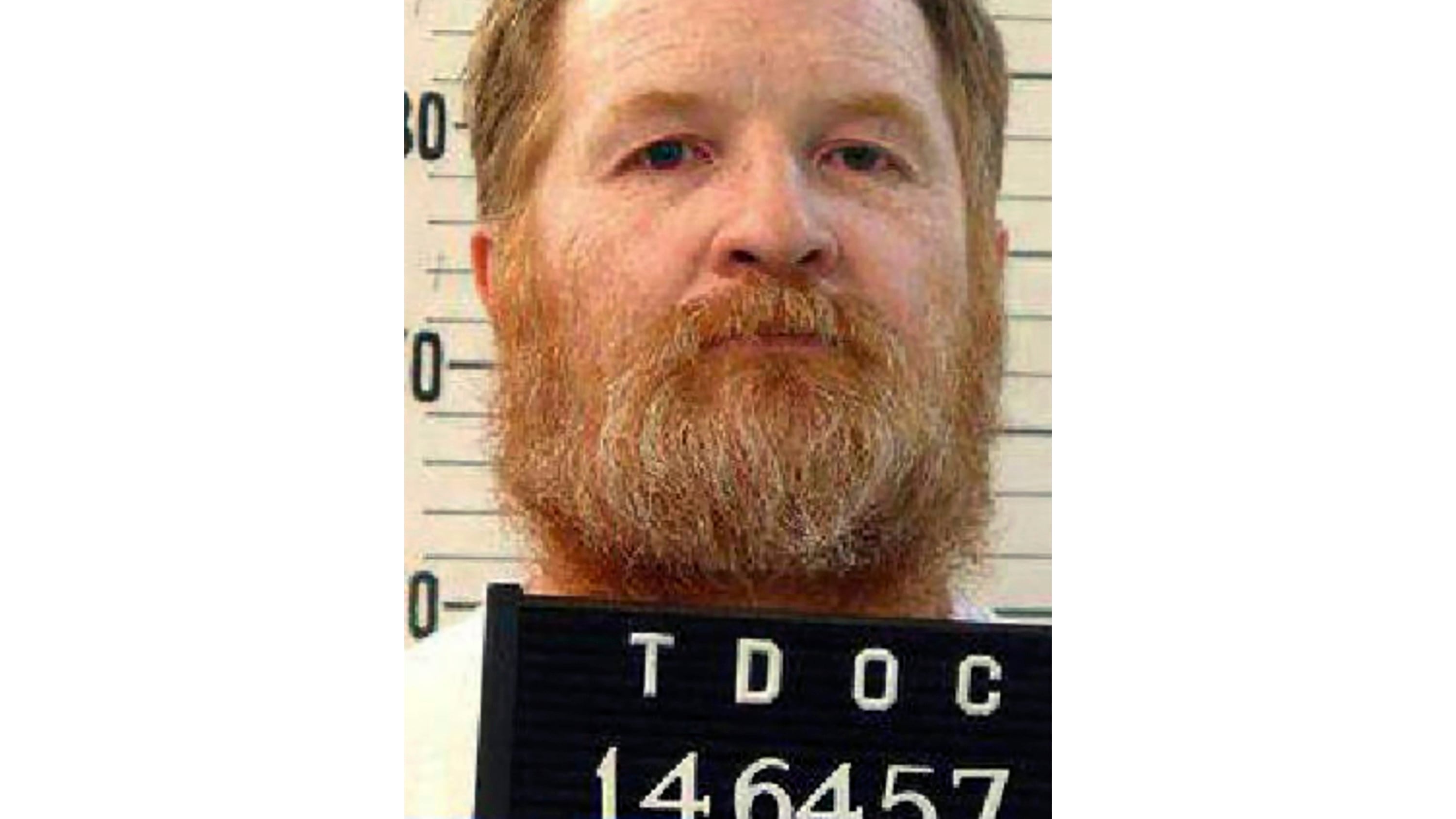
NASHVILLE, Tenn. — Tennessee executed Harold Wayne Nichols by lethal injection Thursday in Nashville for the 1988 rape and murder of Karen Pulley, a 20-year-old student at Chattanooga State University.
Nichols, 64, had confessed to killing Pulley as well as raping several other women in the Chattanooga area. Although he expressed remorse at trial, he admitted he would have continued his violent behavior had he not been arrested. He was sentenced to death in 1990.
“To the people I've harmed, I'm sorry,” Nichols said in his final statement. Before Nichols died, a spiritual adviser spoke to him and recited the Lord’s Prayer. They both became emotional and Nichols nodded as the adviser talked, witnesses said.
Media witnesses reported that a sheet was pulled up to just above Nichols' waist and he was strapped to a gurney with a long tube running to an IV insertion site on the inside of his elbow. There was a spot of blood near the injection site. At one point he took a very heavy breath and his whole torso rose up. He then took a series of short, huffing breaths that witnesses said sounded like snorting or snoring. Nichols’ face turned red and he groaned. His breathing then appeared to slow, then stop, and his face became purple before he was pronounced dead, witnesses said.
Nichols’ attorneys unsuccessfully sought to have his sentence commuted to life in prison, citing the fact that he took responsibility for his crimes and pleaded guilty. His clemency petition stated “he would be the first person to be executed for a crime he pleaded guilty to since Tennessee re-enacted the death penalty in 1978.”
The U.S. Supreme Court declined to issue a stay of the execution on Thursday.
In a recent interview, Pulley's sister, Lisette Monroe, said the wait for Nichols' execution has been "37 years of hell." She described her sister as "gentle, sweet and innocent," and said she hopes that after the execution she'll be able to focus on the happy memories of Pulley instead of her murder.
Jeff Monroe, Lisette Monroe’s husband and Pulley’s brother-in-law, said the family “was destroyed by evil” the night she was killed.
“Taking a life is serious and we take no pleasure in it,” he said during a news conference following the execution. “However, the victims, and there were many, were carefully stalked and attacked. The crimes, and there were many, were deliberate, violent, and horrific.”
Pulley, who was 20 when she was killed, had just finished Bible school and was attending college in Chattanooga to become a paralegal, Jeff Monroe said.
“Karen was bubbly, happy, selfless, and looking forward to the life before her,” he said.
Nichols has seen two previous execution dates come and go. The state earlier planned to execute him in August 2020, but Nichols was given a reprieve due to the COVID-19 pandemic. At that time, Nichols had selected to die in the electric chair — a choice allowed in Tennessee for inmates who were convicted of crimes before January 1999.
Tennessee's lethal injection protocol in 2020 used three different drugs in series, a process that inmates' attorneys claimed was riddled with problems. Their concerns were shown to have merit in 2022, when Gov. Bill Lee paused executions, including a second execution date for Nichols. An independent review of the state's lethal injection process found that none of the drugs prepared for the seven inmates executed in Tennessee since 2018 had been properly tested.
The Tennessee Department of Correction issued a new execution protocol in last December that utilizes the single drug pentobarbital. Attorneys for several death row inmates have sued over the new rules, but a trial in that case is not scheduled until April. Nichols declined to chose an execution method this time, so his execution will be by lethal injection by default.
His attorney Stephen Ferrell explained in an email that “the Tennessee Department of Correction has not provided enough information about Tennessee’s lethal execution protocol for our client to make an informed decision about how the state will end his life.”
Nichols' attorneys on Monday won a court ruling granting access to records from two earlier executions using the new method, but the state has not yet released the records and says it will appeal. During Tennessee's last execution in August, Byron Black said he was "hurting so bad" in his final moments. The state has offered no explanation for what might have caused the pain.
Many states have had difficulty obtaining lethal injection drugs as anti-death penalty activists have put pressure on drug companies and other suppliers. Between the shortages and legal challenges over botched executions, some states have moved to alternative methods of execution including a firing squad in South Carolina and nitrogen gas in Alabama.
Including Nichols, a total of 46 men have died by court-ordered execution this year in the U.S.
Copyright 2025 The Associated Press. All rights reserved. This material may not be published, broadcast, rewritten or redistributed without permission.