

JACKSONVILLE, Fla. — To become a part of the First Alert Neighborhood weather station network powered by Tempest - scan below &/or click * here *:

Some generous rainfall for parts of Northeast Florida & Southeast Georgia. In fact, all areas have had at least some rain from May 8th through the 12th - just what the doctor ordered! But the long term drought continues with JIA more than 16 inches below average since September 1st. Jacksonville had it wettest day on May 12th since early December:

But despite the heavy rain - more than 5-10″ in some parts of Duval, St. Johns, Nassau (Fl.) & Camden Co. (Ga.), it would still take more 1 - 2 feet of rain in some areas of NE Florida & SE Georgia just to break the long term drought.
The inches of rain needed within a 3 month period to significantly lessen the extreme drought (as of May 8):

A few rainfall reports from the Tempest Neighborhood Weather Network Mon.-Tue. May 12-13:
#firstalertwx very impressive rainfall totals this week for parts of NE Florida/SE Georgia - long term drought persists, but this was very beneficial @ActionNewsJax @WOKVNews pic.twitter.com/1NWbUI3R1l
— Mike Buresh (@MikeFirstAlert) May 13, 2026
From the St. Johns River Water Management District:
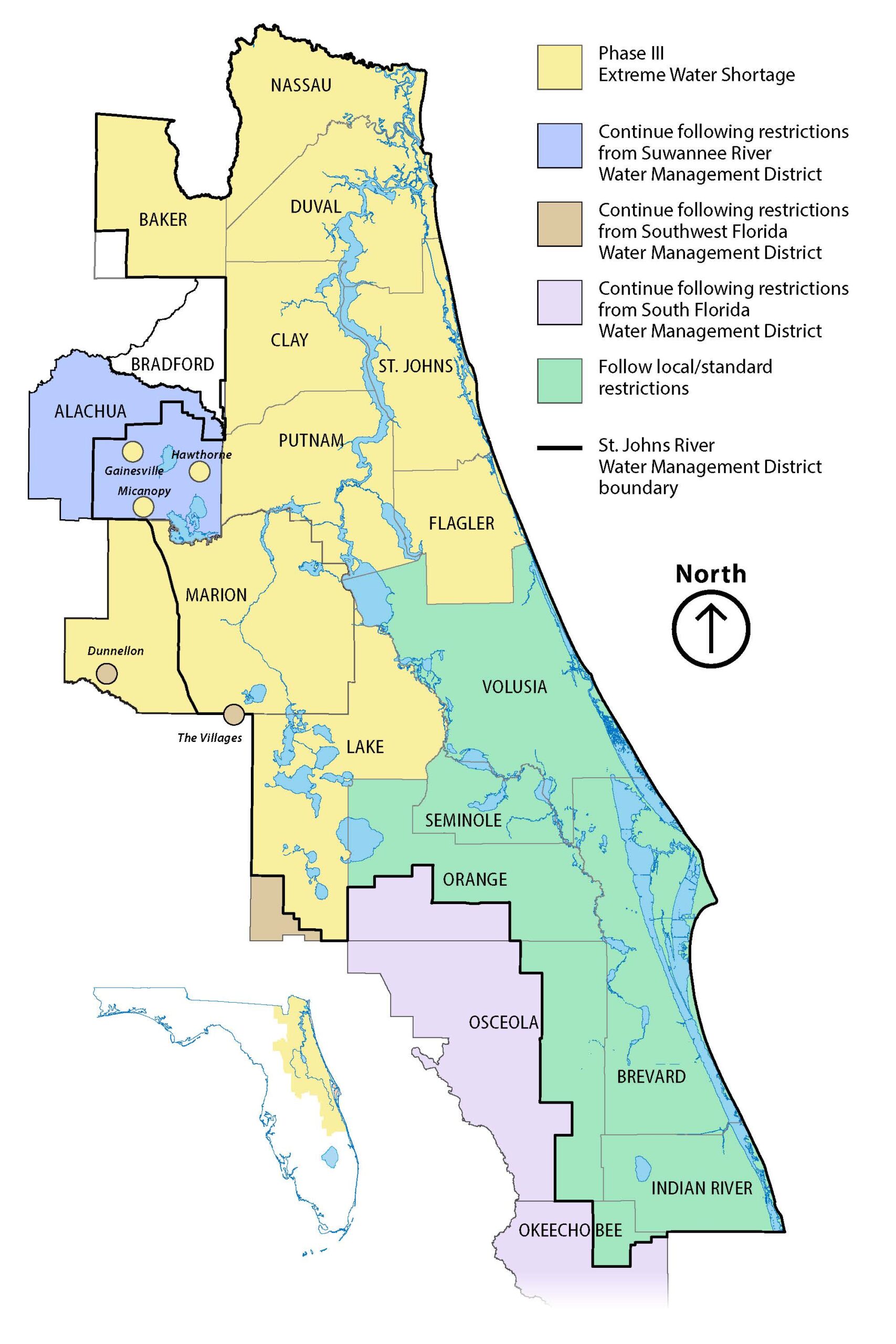
The St. Johns River Water Management District is issuing a Phase III Extreme Water Shortage declaration in response to ongoing exceptional drought conditions, declining groundwater levels and reduced surface water flows across northeast and central Florida.
“The move to Phase III reflects the severity of current drought conditions and the need for immediate action to reduce water demand,” said St. Johns River Water Management District Director of Water Supply and Assessment Clay Coarsey “Protecting our water resources requires a collective effort. Residents, businesses, agricultural operations and large water users all play an important role in helping conserve supplies during these prolonged dry conditions.”
District staff evaluated rainfall totals, aquifer levels, river flows and drought indicators before recommending the action. Despite earlier conservation measures, conditions have continued to worsen due to a lack of rainfall, requiring additional mandatory restrictions to help protect regional water resources.
Under Phase III restrictions, landscape irrigation continues to be limited to one day per week for residential, commercial and institutional properties, including managed landscapes and athletic fields. Restrictions on irrigation for new plantings, including sod, have also been tightened.
Additional Phase III measures include:
- The water shortage order is being expanded into the District’s portion of Lake County.
- Commercial, industrial and institutional users must suspend certain non-essential water uses.
- Irrigation for golf course fairways is limited to one day per week.
- Aesthetic water use is prohibited, and additional restrictions apply to activities such as street and pressure washing.
- Landscape irrigation is prohibited between 8 a.m. and 6 p.m.
The District is urging all water users to eliminate unnecessary water use, suspend non-essential activities and prepare for the possibility of additional restrictions if drought conditions persist.
Outdoor irrigation remains one of the greatest demands on potable water supplies, making conservation efforts especially important during extended periods of dry weather.
The District’s Water Shortage Plan allows for progressively stronger measures if conditions continue to worsen. Taking steps to conserve water now can help reduce strain on water resources and lessen the need for additional restrictions in the future.
If you have not already reset your irrigation timer so that irrigation only occurs one day per week and only between the hours of 6 p.m. and 8 a.m., this should be done immediately. Residents are also encouraged to inspect irrigation systems for leaks and ensure sprinklers are only watering landscaped areas, not streets, sidewalks or driveways, to help prevent unnecessary water waste during ongoing drought conditions.
To view the complete water shortage order, including detailed requirements for each water use category and water conservation tips, visit * here *.
Please note, residents may occasionally see irrigation systems operating in public spaces such as parks, medians and common areas during the water shortage. In many cases, these systems use reclaimed water, which is a highly treated recycled water source that helps reduce demand on potable groundwater supplies. While conservation remains important across all water sources, some reclaimed water systems must continue operating to maintain system function or manage storage capacity.
May night skies (Sky & Telescope):
May 14 (dawn): Mars trails the waning crescent Moon by 7° as they climb above the eastern horizon before sunrise.
May 18 (dusk): The two-day-old Moon hangs in the west-northwest after sunset, with Venus blazing 2° to its lower left. Jupiter joins the scene to the upper left of Venus. The view becomes more dramatic as twilight deepens and the pair sinks toward the horizon.
May 20 (dusk): After sunset, face west to see the delightful lineup of the Moon and the two brightest planets across Gemini. Jupiter is some 7° lower right of the waxing crescent, with Pollux right of the pair forming a triangle. Venus is farther to the lower right.
May 22 (dusk): High in the west-southwest, the first-quarter Moon is 3° to the lower right of Regulus, Leo’s brightest light.
May 26 (dusk): Look south to see the waxing gibbous Moon gleaming 5° to the right of Spica, Virgo’s brightest star.
May 30 (dusk): The almost-full Moon rises in the southeast 2½° ahead of Antares, the smoldering heart of the celestial Scorpion. Large swaths of Oceania and southern South America will see the Moon eclipse the star.
May 31 (all night): The second full Moon this month is called a “Blue Moon” in modern folklore. Its name stems from how infrequently this occurs (7 times every 19 years), not because it will look blue.
June 7 (dusk): Face northwest after sunset to spot Venus 4½° to the lower left of Pollux and Jupiter 2° to the star’s left. See if you can spot Mercury at lower right just above the horizon.
June 9 (dusk): Venus is a mere 1½° to the upper right of Jupiter, creating a dramatic pairing above the western horizon.
Moon Phases
Full Moon May 1 12:23 p.m. EDT (Full Flower Moon)
Last Quarter May 10 5:20 p.m. EDT
New Moon May 17 4:01 p.m. EDT
First Quarter May 23 7:11 a.m. EDT
Full Moon May 31 4:45 a.m. EDT (“Blue Moon”) - 2nd full moon of the month - “blue moon”